

- This event has passed.
Nobel Peace Prize Winning Japanese A-Bomb Survivors Visit Worcester Tuesday, May 5th
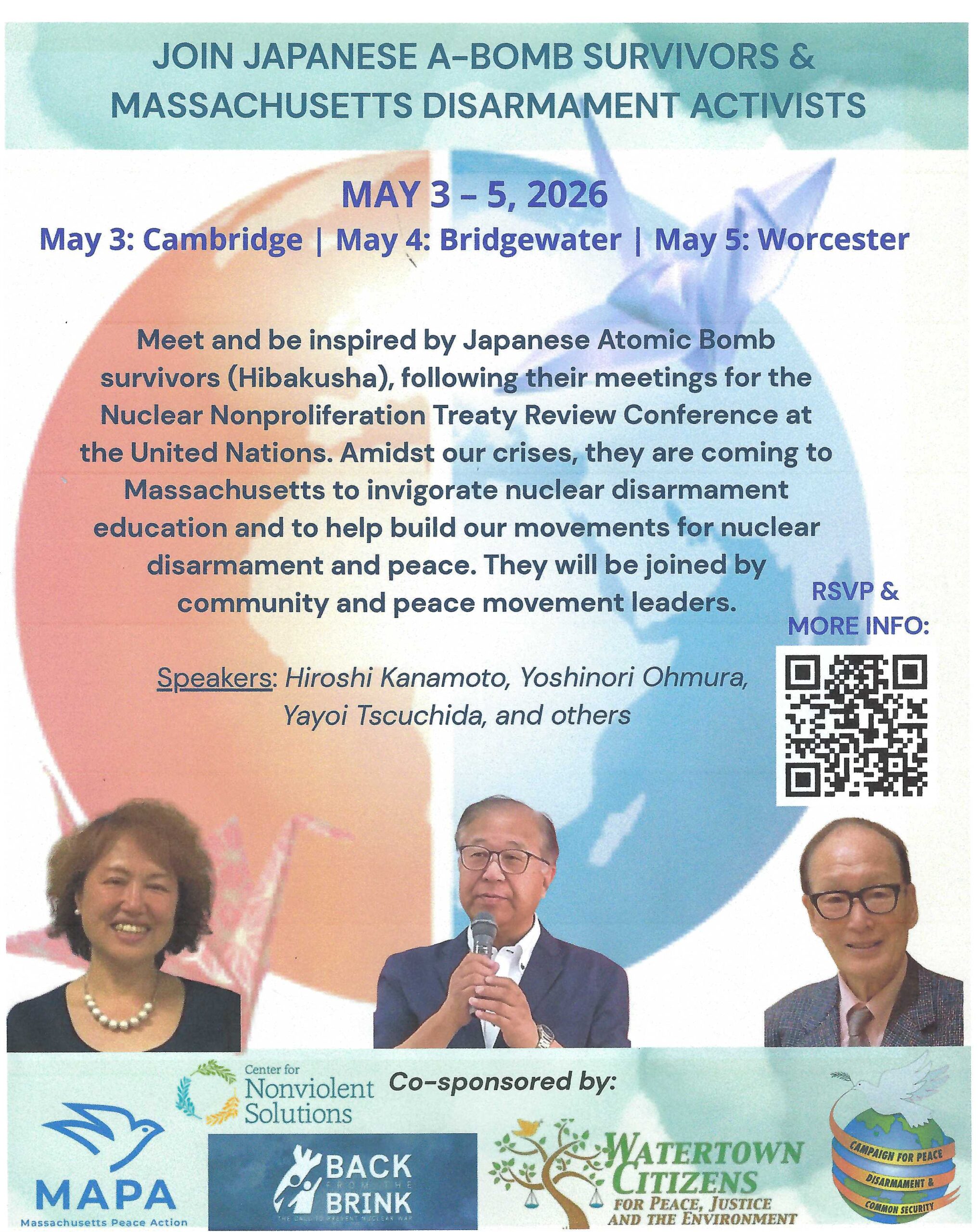
At a moment when nuclear weapons and the threat of nuclear war have returned to the world’s center stage, Massachusetts peace organizations and disarmament advocates are hosting Japanese atomic bomb survivors (Hibakusha)for a statewide speaking tour May 3-5.
Mr. Hiroshi Kanamoto and Mr. Yoshinori Ohmura, leading members of the hibakusha organization Nihon Hidankyo, recipient of the 2024 Nobel Peace Prize, along with Ms. Yayoi Tsuchida, Assistant General Secretary of the Japan Council against A- & H- Bombs, and Japanese journalist Ms. Keiko Kaku will attend events in Cambridge, Bridgewater State University, and Worcester. Their visit follows their participation in the Nuclear Nonproliferation Treaty Review Conference at the United Nations in New York.
The Center for Nonviolent Solutions, a local organization engaged in peace education and peace advocacy, is coordinating the A-bomb survivors’ day-long visit to Worcester.
Organizers of the state-wide tour are: Campaign for Peace, Disarmament and Common Security, Massachusetts Peace Action, Rotarians for a Nuclear Weapons Free World, the Bridgewater ICP Council, and Center for Nonviolent Solutions.
Worcester Itinerary, Tuesday, May 5th
Noon-1:30 pm. Lunch with Holy Cross students and welcome from Holy Cross College President Vincent Rougeau. Hosted by McFarland Center for Religion, Ethics and Culture.
3-5 p.m: Community welcome and press conference at Mechanics Hall (Washburn Rm) Speakers include representatives from two organizations that received the Nobel Peace Prize.
5:45-6:45 p.m: Mayoral welcome, Key to the City Ceremony and hibakusha address to Worcester City Council
7:30 p.m. Public lecture at First Unitarian Church, Main Street.
Background on Japanese Delegation
Hiroshi Kanamoto, 80, is a Hiroshima A-bomb survivor and representative director of the Japan Federation of A- and H-Bomb Sufferers Organization (Nihon Hidankyo). He was 9 months old when the U.S. dropped the atomic bomb on Hiroshima on August 6, 1945. He was being carried on the back of his 15-year-old sister, Taeko. The blast buried him under debris, leaving him barely breathing. He was later revived by a man who, decades later, Mr. Kanamoto learned was his father, who soon thereafter as a result of the A-bombing. Mr. Kanamoto has given testimonies in Japan and internationally, including at the UN in New York, where he warned that the “nuclear taboo” is “beginning to shake” and that the world is in a “very dangerous” state.
Yoshinori Ohmura is a leading second-generation A-bomb survivor. These are children of people directly affected by the U.S. atomic bombings, some of whom have suffered genetic damages and live with fears of increased vulnerability to cancers and other radiation diseases. Many fear identifying themselves as second-generation hibakusha for fear of discrimination and prejudice. It is estimated that there are between 300,000 and 500,000 second generation Hibakusha.
Yayoi Tsuchida is the Assistant Secretary General of the Japan Council against A- & H-Bombs. She has coordinated arrangements for a 180-member delegation of Japanese and South Korean Hibakusha to the NPT Review Conference, spoken in side events there, and plays a leading role in organizing the annual August World Conference against A-and H-Bombs in Hiroshima and Nagasaki.